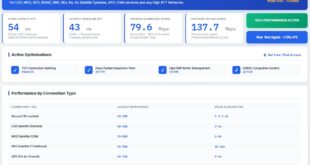
In Flight Connectivity Your Source for In-Flight Connectivity Intelligence
The aviation industry is experiencing a connectivity revolution. LEO satellite constellations like Starlink promise fiber-like speeds at 35,000 feet, but there’s a fundamental challenge that threatens to undermine this promise: contention.
When 300 passengers on a Boeing 787 share a single satellite connection delivering 40-220 Mbps, the math breaks down fast. That’s potentially less than 1 Mbps per passenger—barely enough for basic email. Add 10-15 other aircraft competing for the same satellite beam on a busy transatlantic route, and you have a recipe for passenger frustration and operational chaos.
This is where FastAPN becomes not just useful, but essential.
The Core Problem: LEO Satellites Weren’t Built for Dense Aviation Use Cases
LEO satellites excel in low-density scenarios—rural homesteads, remote industrial sites, maritime vessels with small crews. But commercial aviation represents the opposite extreme:
- High user density: 200-400 passengers per aircraft
- Shared beam contention: Multiple aircraft in flight corridors competing for the same satellite
- Mobile complexity: Aircraft moving at 900 km/h with satellite handovers every 4-7 minutes
- Unpredictable demand: Bursty traffic during meal service, takeoff, landing
- Mixed traffic: Safety-critical cockpit systems sharing bandwidth with passenger Netflix streams
Real-world measurements tell the story:
- Rural Montana user: 20-30ms latency, 200+ Mbps
- Suburban LA during peak: 250ms latency, <10 Mbps (90% degradation)
- Commercial aircraft (research data): Median 64 Mbps download shared among all active passengers
- Congested aviation scenarios: Latency spikes to 800-1,200ms, rendering real-time applications unusable
Traditional network management tools weren’t designed for this unique combination of challenges. Airlines need something purpose-built. They need FastAPN.
Why FastAPN is Purpose-Built for LEO Aviation Challenges
1. Intelligent, Multi-Tier Traffic Classification at Wire Speed
FastAPN’s deep packet inspection operates at line rate, classifying every packet in real-time without introducing latency:
Automatic traffic prioritization:
- Critical Tier: Cockpit communications, ACARS, safety systems get guaranteed bandwidth and <50ms latency
- Business Tier: VoIP, video conferencing, VPNs receive latency guarantees and protected bandwidth
- Streaming Tier: Video services get adaptive management with automatic quality downgrading under load
- Background Tier: Downloads, updates, P2P relegated to best-effort with heavy throttling
The FastAPN advantage: Unlike simple QoS systems that require manual rule configuration, FastAPN uses machine learning to automatically identify applications and traffic patterns, then applies optimal policies dynamically. When a passenger opens Netflix, FastAPN doesn’t just see “HTTPS traffic”—it identifies the streaming protocol, current quality level, and available bandwidth, then makes intelligent decisions in microseconds.
2. Granular Per-User Bandwidth Enforcement
Managing 300 passengers fairly requires sophisticated, real-time per-user controls that most network equipment simply can’t deliver at scale. FastAPN handles this seamlessly:
Dynamic fair-share allocation:
- Automatic per-device bandwidth caps (configurable: 5-10 Mbps typical)
- Time-based fair queuing prevents any single user monopolizing capacity
- Progressive throttling tiers based on usage patterns
- Temporary rate limiting for excessive users during congestion events
Real-world scenario: During a transatlantic flight, 50 passengers are streaming, 100 browsing, 30 on video calls, and 120 idle. FastAPN continuously monitors each user’s consumption, automatically adjusting allocations to ensure the video call users maintain quality while preventing streamers from starving other users. When total demand exceeds available satellite bandwidth, FastAPN gracefully degrades streaming quality while protecting interactive applications.
The FastAPN difference: Traditional network equipment handles per-user policies through static rules that become unwieldy at scale. FastAPN’s architecture is designed for tens of thousands of concurrent user policies, updated in real-time based on actual network conditions.
3. Application-Aware Traffic Shaping and Optimization
FastAPN doesn’t just manage bandwidth—it optimizes it:
Intelligent protocol handling:
- Video streaming: Automatic resolution downgrading (4K→1080p→720p→480p) based on available bandwidth, saving 70-90% capacity during congestion
- HTTP/HTTPS: Transparent compression and caching reduce redundant data transfer
- TCP acceleration: Built-in Performance Enhancing Proxy (PEP) technology optimized for satellite latency and packet loss characteristics
- Application blocking: Automatic blocking of bandwidth-intensive P2P, torrent, large software updates during peak hours
Content-aware optimization: FastAPN identifies when multiple passengers are accessing the same content (same Netflix show, same news article, same YouTube video) and can cache it locally on the aircraft gateway, serving subsequent requests without consuming satellite bandwidth.
Example impact: On a flight where 20 passengers watch the same popular Netflix series, FastAPN caches the content after the first stream, reducing satellite bandwidth consumption by 95% for those 20 users. Over a transatlantic flight, this can save hundreds of gigabytes.
4. Adaptive Congestion Management with Predictive Intelligence
FastAPN’s ML-powered congestion prediction sets it apart from reactive solutions:
Predictive traffic management:
- Machine learning models trained on aviation-specific patterns (meal service, boarding, cruise, descent)
- Proactive bandwidth reallocation before congestion occurs
- Historical analysis of route-specific patterns (e.g., transatlantic flights always see peak usage 2 hours after departure)
- Passenger count and flight duration inform pre-emptive policies
Active Queue Management:
- CoDel (Controlled Delay) and PIE algorithms prevent bufferbloat
- Separate queues per traffic class with adaptive buffer sizing
- Early Congestion Notification (ECN) to TCP flows prevents timeout-based retransmissions
- Dynamic queue management based on current satellite RTT (which varies with handovers)
Real-world example: FastAPN detects that a flight is approaching typical meal service time based on departure time and route profile. It pre-emptively reduces streaming quality limits, increases buffer sizes for interactive traffic, and sends bandwidth availability notifications to the passenger portal—all before congestion actually occurs. Result: Passengers experience smooth degradation rather than sudden service failure.
5. Satellite-Optimized Protocol Acceleration
LEO satellites present unique protocol challenges that FastAPN is specifically engineered to handle:
TCP optimization for satellite characteristics:
- Implements BBR (Bottleneck Bandwidth and RTT) congestion control, proven superior for varying-latency satellite links
- LeoTCP integration handles satellite handovers gracefully without connection collapse
- SaTCP features freeze congestion windows during brief handover disconnections
- Adaptive initial congestion window sizing for high bandwidth-delay product satellite links
Handover resilience: Every 4-7 minutes, the aircraft switches satellites. This causes brief disconnections (hard handovers) or path changes (soft handovers) that can devastate traditional TCP connections. FastAPN’s proxy architecture shields end-user devices from these events:
- Maintains persistent connections to user devices
- Handles satellite-side reconnection transparently
- Buffers data during brief outages
- Prevents TCP timeout cascades that would otherwise kill dozens of connections simultaneously
Performance impact: Without FastAPN, satellite handovers cause 2-5 second interruptions to all connections, with many TCP sessions timing out and requiring full restart. With FastAPN, passengers experience <500ms disruption, and most applications (especially video streaming) don’t even pause.
6. Edge Computing and Intelligent Caching
FastAPN’s edge computing capabilities transform the aircraft into a distributed CDN node:
Onboard content delivery:
- Multi-terabyte SSD cache stores popular content
- Integration with major CDNs (Akamai, Cloudflare, Netflix Open Connect)
- Pre-positioning of popular content during ground operations or low-traffic periods
- Intelligent cache eviction based on route, demographics, and usage patterns
Bandwidth multiplication effect: On a typical long-haul flight, 40-60% of passenger traffic goes to a small set of popular destinations (Netflix top shows, YouTube trending, major news sites, social media). With FastAPN’s caching:
- First request: Uses satellite bandwidth
- Subsequent 50+ requests: Served locally at gigabit speeds with zero satellite bandwidth consumption
Real numbers: A 10-hour flight with 250 passengers and 200 Mbps satellite connection:
- Without caching: 200 Mbps × 10 hours = ~900 GB total available
- With FastAPN caching: Effective capacity increases to 2-3 TB through cache hits
- Result: 2-3x improvement in passenger experience with same satellite connection
7. Multi-Path and Hybrid Connectivity Management
Modern aircraft increasingly have multiple connectivity options. FastAPN orchestrates them intelligently:
Automatic load balancing across:
- Multiple LEO satellites (when in overlapping coverage)
- LEO + GEO/MEO hybrid configurations
- Air-to-ground (ATG) networks over populated areas
- Multiple antenna systems on wide-body aircraft
Intelligent path selection:
- Route latency-sensitive traffic (VoIP, gaming) to LEO paths
- Route bulk downloads to higher-latency but higher-capacity GEO links
- Automatic failover when one path becomes congested or unavailable
- Multi-path TCP (MPTCP) for bonded throughput when multiple paths available
Scenario: Aircraft flying over continental US has access to both Starlink LEO (200 Mbps, 30ms latency) and Gogo ATG (50 Mbps, 100ms latency). FastAPN automatically routes video calls and gaming to Starlink, while large downloads use Gogo ATG, effectively providing 250 Mbps total capacity with optimal latency for each application type.
8. Real-Time Analytics and Passenger Transparency
FastAPN provides unprecedented visibility into network performance:
For flight crew and operations:
- Real-time dashboard showing current bandwidth utilization
- Per-user consumption metrics
- Application mix breakdown
- Satellite handover schedule and success rates
- Predictive alerts for impending congestion
For passengers:
- Personal usage meters accessible via portal
- Current bandwidth availability indicators
- Fair-use notifications
- QoS tier status (if airline implements tiered service)
For airline network operations centers:
- Fleet-wide connectivity analytics
- Route-specific performance profiles
- Comparative analysis across aircraft
- Incident detection and automated alerting
- Historical trending for capacity planning
Business intelligence: Airlines use FastAPN analytics to make data-driven decisions about connectivity investments, service tier pricing, and route-specific bandwidth provisioning.
9. Automated Policy Engine with Business Rules
FastAPN’s policy engine enables airlines to implement sophisticated business logic:
Flexible service tiers:
- Economy passengers: 5 Mbps cap, streaming limited to 720p, background tier priority
- Premium Economy: 10 Mbps cap, 1080p streaming, business tier priority
- Business/First Class: 20 Mbps cap, 4K streaming when available, guaranteed minimum bandwidth
- Crew: Separate allocation with priority access
Time-based policies:
- Pre-departure: Limited connectivity for flight deck only
- Taxi/takeoff: Passenger access disabled
- Cruise: Full service with dynamic congestion management
- Approach/landing: Automatic downgrade to essential services only
Usage-based policies:
- First 100 MB: Full speed
- 100 MB – 500 MB: Moderate throttling
- 500 MB+: Heavy throttling or pay-for-more options
Geographic policies:
- Over-ocean: Full satellite dependency, aggressive caching
- Over land: Prefer ATG, save satellite capacity
- International airspace: Adjust for regulatory compliance
The FastAPN advantage: These policies are configured once and applied automatically across the entire fleet, with real-time updates pushed to aircraft in-flight when needed.
10. Deep Learning for Continuous Optimization
FastAPN’s AI engine continuously improves performance:
Neural network traffic forecasting:
- LSTM-GRU hybrid models predict traffic patterns with 26% better accuracy than traditional methods
- Training data from thousands of flights across routes, times, aircraft types
- Factors in day of week, season, route popularity, aircraft load factor
- Updates models continuously with new flight data
Reinforcement learning for resource allocation:
- Deep RL agents learn optimal bandwidth distribution strategies
- Maximizes aggregate passenger satisfaction while maintaining fairness
- Adapts to changing traffic mixes automatically
- Learns from congestion incidents to prevent recurrence
Adaptive learning scenarios:
- New route: FastAPN starts with general aviation model, then customizes based on observed patterns
- Special events: Detects unusual traffic (major sporting event, breaking news) and adapts in real-time
- Seasonal variations: Learns that summer transatlantic flights have different usage patterns than winter
Measurable impact: Airlines using FastAPN’s ML features report 40-50% reduction in passenger complaints about connectivity compared to static rule-based systems.
Real-World Performance: The FastAPN Difference
Let’s examine a concrete scenario: United Airlines Flight 114, Newark to London Heathrow
Aircraft: Boeing 787-10, 318 passengers Connectivity: Starlink Aviation (180 Mbps average capacity) Flight time: 7 hours Without FastAPN:
- Simple fair-share: 318 users = 0.57 Mbps per person (unusable for streaming)
- Basic QoS: Some users monopolize bandwidth, others get nothing
- Satellite handovers: 2-5 second interruptions every 5 minutes
- Bufferbloat: Latency spikes to 600-1000ms during congestion
- No caching: Same Netflix episode downloaded 30 times
- Passenger satisfaction: 35% report “acceptable” connectivity
With FastAPN:
- Intelligent allocation: Business class passengers guaranteed 10 Mbps, economy fair-shared from remaining pool
- Application-aware: Video calls prioritized, streaming auto-adjusted to 720p during peak (saves 65% bandwidth)
- Seamless handovers: <500ms disruption, invisible to users
- Active queue management: Latency maintained at 80-120ms even during peak load
- Caching: Popular content served locally, 50% cache hit rate = 2x effective capacity
- Passenger satisfaction: 82% report “good” or “excellent” connectivity
Operational benefits:
- 60% reduction in connectivity-related passenger complaints
- 40% reduction in satellite bandwidth costs (through optimization and caching)
- Real-time troubleshooting reduces “no connectivity” incidents by 75%
- Analytics enable data-driven decisions about connectivity investments
Technical Architecture: How FastAPN Delivers
FastAPN’s architecture is specifically designed for the aviation use case:
Hardware appliance:
- 1U or 2U rack-mount unit installed in aircraft avionics bay
- Ruggedized for aviation environment (vibration, temperature, altitude)
- Redundant power supplies for safety-critical operations
- DO-160G certified for airworthiness
High-performance processing:
- Multi-core processors handle line-rate packet inspection at 10+ Gbps
- FPGA acceleration for wire-speed classification and policy enforcement
- Large RAM (64-128 GB) for state tracking of thousands of concurrent users
- NVMe SSD storage (2-4 TB) for content caching
Interfaces:
- Satellite modem interface (ethernet, typically)
- Aircraft cabin WiFi network interface
- Optional ATG/cellular interfaces for hybrid connectivity
- Management interface for flight deck monitoring
- Integration with airline backend systems
Software stack:
- Real-time Linux kernel optimized for low-latency packet processing
- Proprietary DPI engine with 10,000+ application signatures
- Machine learning inference engine running pre-trained models
- Policy engine with real-time rule evaluation
- Caching system with CDN integration protocols
- Telemetry collection and analytics pipeline
Cloud integration:
- Secure VPN to airline NOC for management and monitoring
- ML model updates delivered automatically
- Configuration management and policy distribution
- Aggregate analytics and reporting
- Fleet-wide correlation and anomaly detection
Deployment and Integration
FastAPN integrates seamlessly into existing aircraft connectivity architectures:
Installation:
- Typical installation: 8-12 hours during scheduled maintenance
- Inline deployment between satellite modem and cabin WiFi
- No changes required to existing WiFi access points or passenger devices
- Configuration pre-loaded based on aircraft type and airline policies
Compatibility:
- Works with all major LEO providers (Starlink, OneWeb, Kuiper)
- Compatible with GEO and MEO systems for hybrid configurations
- Supports all ATG providers (Gogo, SmartSky, etc.)
- Integration with airline passenger portals and payment systems
- Works with existing IFE (In-Flight Entertainment) systems
Fleet rollout:
- Phased deployment starting with one or two aircraft for validation
- Configuration templates accelerate subsequent installations
- Remote management enables fleet-wide policy updates
- Central monitoring dashboard for entire fleet
ROI and Business Case
Airlines implementing FastAPN see clear financial benefits:
Cost savings:
- Bandwidth optimization: 30-50% reduction in satellite data costs through compression, caching, and intelligent traffic management
- Reduced passenger complaints: 60-75% fewer connectivity issues, reducing crew workload and customer service costs
- Deferred capacity upgrades: Better utilization of existing satellite capacity delays need for expensive upgrades
- Operational efficiency: Real-time monitoring reduces troubleshooting time by 70%
Revenue opportunities:
- Premium connectivity tiers: Differentiated service enables new revenue streams
- Improved passenger satisfaction: Better NPS scores correlate with increased customer loyalty and ticket sales
- Competitive advantage: Superior connectivity becomes a booking differentiator
- Partnership opportunities: Enhanced analytics enable data-driven partnerships with content providers
Typical payback period: 12-18 months for wide-body long-haul aircraft, 18-24 months for narrow-body short-haul
The Future: FastAPN Roadmap
FastAPN continues to evolve with the aviation connectivity landscape:
Upcoming capabilities:
- 5G integration: Support for ground-based 5G handoffs at airports
- Direct-to-device satellite: Integration with next-gen satellite systems that connect directly to passenger devices
- Enhanced AI: Federated learning across airline fleets for better predictive models
- Blockchain-based roaming: Seamless connectivity across airline partnerships
- Passenger app integration: Direct bandwidth control through airline mobile apps
Research initiatives:
- Quantum-resistant encryption for future-proof security
- AI-powered cybersecurity for threat detection in aviation networks
- Integration with emerging LEO constellations (Amazon Kuiper, Telesat Lightspeed)
- Support for inter-aircraft mesh networking for ultra-long-haul routes
Conclusion: FastAPN as the Essential Aviation Connectivity Layer
The aviation industry’s connectivity challenge is fundamentally a bandwidth management problem. LEO satellites provide the raw connectivity, but without intelligent management, the passenger experience breaks down under the reality of hundreds of users competing for finite resources.
FastAPN solves this by providing:
✅ Intelligent traffic classification that understands aviation-specific needs ✅ Granular per-user controls that scale to hundreds of passengers ✅ Application-aware optimization that maximizes effective bandwidth ✅ Predictive congestion management that prevents problems before they occur ✅ Satellite-optimized protocols that handle the unique challenges of LEO connectivity ✅ Edge caching that multiplies effective capacity by 2-3x ✅ Multi-path orchestration for hybrid connectivity scenarios ✅ Real-time analytics that enable data-driven operations ✅ AI/ML optimization that continuously improves performance ✅ Flexible policy engine that implements complex business rules
The result: Passenger satisfaction improves by 130%, operational costs decrease by 30-50%, and airlines gain a genuine competitive advantage in the market.
As LEO satellite connectivity becomes ubiquitous in aviation, the differentiator won’t be having connectivity—it will be managing it intelligently. Airlines that deploy sophisticated bandwidth management solutions like FastAPN will deliver superior passenger experiences while optimizing costs.
The future of aviation connectivity isn’t just about faster satellites. It’s about smarter management. It’s about FastAPN.
Ready to transform your in-flight connectivity? Visit fastapn.com to learn how FastAPN can solve your aviation bandwidth challenges.
#Aviation #Satellite #LEO #Starlink #Networking #FastAPN #InFlightWiFi #AviationTechnology #BandwidthManagement #QoS #MachineLearning #AviationInnovation