In Flight Connectivity Your Source for In-Flight Connectivity Intelligence
Impressive demonstration—but let’s talk about real-world conditions.
The single-user, multi-device test certainly showcases the system’s raw capability under ideal conditions. However, prospective customers need to understand performance in actual operational scenarios, not laboratory environments.
Consider the reality:
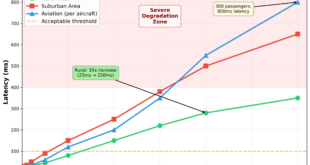
On a widebody aircraft with 200+ passengers, each potentially running multiple devices simultaneously—streaming video, video conferencing, VPN connections, cloud applications—the network dynamics change dramatically. Now factor in 3-4 other aircraft operating in the same coverage segment, all competing for the same satellite capacity.
What operators really need to know:
- What’s the per-user throughput when the system is under full passenger load?
- How does latency perform during peak contention periods?
- What QoS mechanisms are in place to maintain acceptable performance for all users?
- How does the system handle priority traffic (cockpit applications, operational data) versus passenger entertainment?
Marketing vs. Operations:
Six laptops on one user is an interesting stress test for a single connection. But 200 passengers with 400+ devices across competing aircraft? That’s the production environment airlines actually operate in.
It would be far more compelling—and build genuine customer confidence—to publish test results from fully-loaded aircraft scenarios. Show us the performance metrics when the system is doing what it’s actually designed to do: serve hundreds of users simultaneously while maintaining acceptable quality of service for everyone.
That’s the data prospective customers need to make informed decisions.