In Flight Connectivity Your Source for In-Flight Connectivity Intelligence



Recent Posts
The Ultimate Solution for Managing Best-Effort LEO Satellite Services in Aviation
The aviation industry is experiencing a connectivity revolution. LEO satellite constellations like Starlink promise fiber-like speeds at 35,000 feet, but there’s a fundamental challenge that threatens to undermine this promise: contention.
When 300 passengers on a Boeing 787 share a single satellite connection delivering 40-220 Mbps, the math breaks down fast. That’s potentially less than 1 Mbps per passenger—barely enough for basic email. Add 10-15 other aircraft competing for the same satellite beam on a busy transatlantic route, and you have a recipe for passenger frustration and operational chaos.
This is where FastAPN becomes not just useful, but essential.
The Core Problem: LEO Satellites Weren’t Built for Dense Aviation Use Cases
LEO satellites excel in low-density scenarios—rural homesteads, remote industrial sites, maritime vessels with small crews. But commercial aviation represents the opposite extreme:
- High user density: 200-400 passengers per aircraft
- Shared beam contention: Multiple aircraft in flight corridors competing for the same satellite
- Mobile complexity: Aircraft moving at 900 km/h with satellite handovers every 4-7 minutes
- Unpredictable demand: Bursty traffic during meal service, takeoff, landing
- Mixed traffic: Safety-critical cockpit systems sharing bandwidth with passenger Netflix streams
Real-world measurements tell the story:
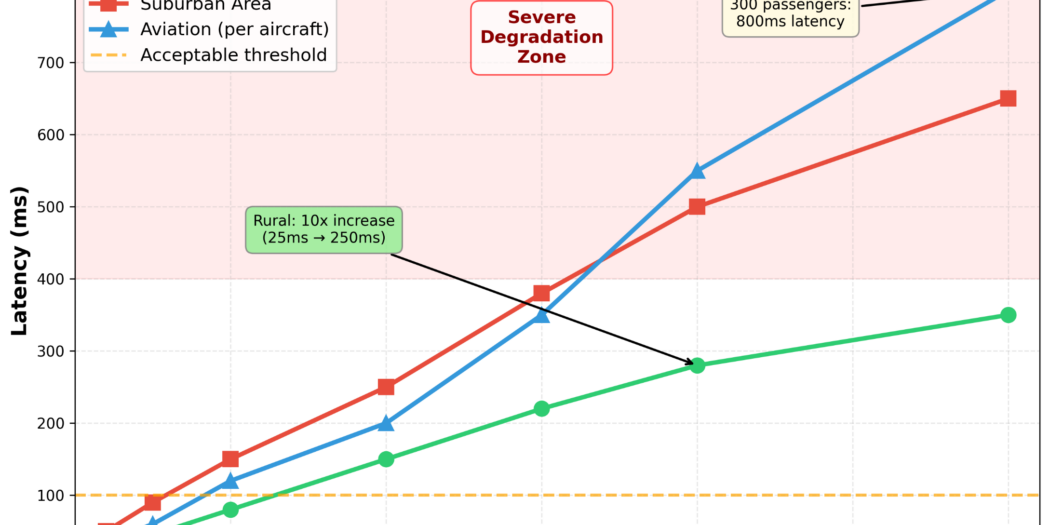
- Rural Montana user: 20-30ms latency, 200+ Mbps
- Suburban LA during peak: 250ms latency, <10 Mbps (90% degradation)
- Commercial aircraft (research data): Median 64 Mbps download shared among all active passengers
- Congested aviation scenarios: Latency spikes to 800-1,200ms, rendering real-time applications unusable
Traditional network management tools weren’t designed for this unique combination of challenges. Airlines need something purpose-built. They need FastAPN.
Why FastAPN is Purpose-Built for LEO Aviation Challenges
1. Intelligent, Multi-Tier Traffic Classification at Wire Speed
FastAPN’s deep packet inspection operates at line rate, classifying every packet in real-time without introducing latency:
Automatic traffic prioritization:
- Critical Tier: Cockpit communications, ACARS, safety systems get guaranteed bandwidth and <50ms latency
- Business Tier: VoIP, video conferencing, VPNs receive latency guarantees and protected bandwidth
- Streaming Tier: Video services get adaptive management with automatic quality downgrading under load
- Background Tier: Downloads, updates, P2P relegated to best-effort with heavy throttling
The FastAPN advantage: Unlike simple QoS systems that require manual rule configuration, FastAPN uses machine learning to automatically identify applications and traffic patterns, then applies optimal policies dynamically. When a passenger opens Netflix, FastAPN doesn’t just see “HTTPS traffic”—it identifies the streaming protocol, current quality level, and available bandwidth, then makes intelligent decisions in microseconds.
2. Granular Per-User Bandwidth Enforcement
Managing 300 passengers fairly requires sophisticated, real-time per-user controls that most network equipment simply can’t deliver at scale. FastAPN handles this seamlessly:
Dynamic fair-share allocation:
- Automatic per-device bandwidth caps (configurable: 5-10 Mbps typical)
- Time-based fair queuing prevents any single user monopolizing capacity
- Progressive throttling tiers based on usage patterns
- Temporary rate limiting for excessive users during congestion events
Real-world scenario: During a transatlantic flight, 50 passengers are streaming, 100 browsing, 30 on video calls, and 120 idle. FastAPN continuously monitors each user’s consumption, automatically adjusting allocations to ensure the video call users maintain quality while preventing streamers from starving other users. When total demand exceeds available satellite bandwidth, FastAPN gracefully degrades streaming quality while protecting interactive applications.
The FastAPN difference: Traditional network equipment handles per-user policies through static rules that become unwieldy at scale. FastAPN’s architecture is designed for tens of thousands of concurrent user policies, updated in real-time based on actual network conditions.
3. Application-Aware Traffic Shaping and Optimization
FastAPN doesn’t just manage bandwidth—it optimizes it:
Intelligent protocol handling:
- Video streaming: Automatic resolution downgrading (4K→1080p→720p→480p) based on available bandwidth, saving 70-90% capacity during congestion
- HTTP/HTTPS: Transparent compression and caching reduce redundant data transfer
- TCP acceleration: Built-in Performance Enhancing Proxy (PEP) technology optimized for satellite latency and packet loss characteristics
- Application blocking: Automatic blocking of bandwidth-intensive P2P, torrent, large software updates during peak hours
Content-aware optimization: FastAPN identifies when multiple passengers are accessing the same content (same Netflix show, same news article, same YouTube video) and can cache it locally on the aircraft gateway, serving subsequent requests without consuming satellite bandwidth.
Example impact: On a flight where 20 passengers watch the same popular Netflix series, FastAPN caches the content after the first stream, reducing satellite bandwidth consumption by 95% for those 20 users. Over a transatlantic flight, this can save hundreds of gigabytes.
4. Adaptive Congestion Management with Predictive Intelligence
FastAPN’s ML-powered congestion prediction sets it apart from reactive solutions:
Predictive traffic management:
- Machine learning models trained on aviation-specific patterns (meal service, boarding, cruise, descent)
- Proactive bandwidth reallocation before congestion occurs
- Historical analysis of route-specific patterns (e.g., transatlantic flights always see peak usage 2 hours after departure)
- Passenger count and flight duration inform pre-emptive policies
Active Queue Management:
- CoDel (Controlled Delay) and PIE algorithms prevent bufferbloat
- Separate queues per traffic class with adaptive buffer sizing
- Early Congestion Notification (ECN) to TCP flows prevents timeout-based retransmissions
- Dynamic queue management based on current satellite RTT (which varies with handovers)
Real-world example: FastAPN detects that a flight is approaching typical meal service time based on departure time and route profile. It pre-emptively reduces streaming quality limits, increases buffer sizes for interactive traffic, and sends bandwidth availability notifications to the passenger portal—all before congestion actually occurs. Result: Passengers experience smooth degradation rather than sudden service failure.
5. Satellite-Optimized Protocol Acceleration
LEO satellites present unique protocol challenges that FastAPN is specifically engineered to handle:
TCP optimization for satellite characteristics:
- Implements BBR (Bottleneck Bandwidth and RTT) congestion control, proven superior for varying-latency satellite links
- LeoTCP integration handles satellite handovers gracefully without connection collapse
- SaTCP features freeze congestion windows during brief handover disconnections
- Adaptive initial congestion window sizing for high bandwidth-delay product satellite links
Handover resilience: Every 4-7 minutes, the aircraft switches satellites. This causes brief disconnections (hard handovers) or path changes (soft handovers) that can devastate traditional TCP connections. FastAPN’s proxy architecture shields end-user devices from these events:
- Maintains persistent connections to user devices
- Handles satellite-side reconnection transparently
- Buffers data during brief outages
- Prevents TCP timeout cascades that would otherwise kill dozens of connections simultaneously
Performance impact: Without FastAPN, satellite handovers cause 2-5 second interruptions to all connections, with many TCP sessions timing out and requiring full restart. With FastAPN, passengers experience <500ms disruption, and most applications (especially video streaming) don’t even pause.
6. Edge Computing and Intelligent Caching
FastAPN’s edge computing capabilities transform the aircraft into a distributed CDN node:
Onboard content delivery:
- Multi-terabyte SSD cache stores popular content
- Integration with major CDNs (Akamai, Cloudflare, Netflix Open Connect)
- Pre-positioning of popular content during ground operations or low-traffic periods
- Intelligent cache eviction based on route, demographics, and usage patterns
Bandwidth multiplication effect: On a typical long-haul flight, 40-60% of passenger traffic goes to a small set of popular destinations (Netflix top shows, YouTube trending, major news sites, social media). With FastAPN’s caching:
- First request: Uses satellite bandwidth
- Subsequent 50+ requests: Served locally at gigabit speeds with zero satellite bandwidth consumption
Real numbers: A 10-hour flight with 250 passengers and 200 Mbps satellite connection:
- Without caching: 200 Mbps × 10 hours = ~900 GB total available
- With FastAPN caching: Effective capacity increases to 2-3 TB through cache hits
- Result: 2-3x improvement in passenger experience with same satellite connection
7. Multi-Path and Hybrid Connectivity Management
Modern aircraft increasingly have multiple connectivity options. FastAPN orchestrates them intelligently:
Automatic load balancing across:
- Multiple LEO satellites (when in overlapping coverage)
- LEO + GEO/MEO hybrid configurations
- Air-to-ground (ATG) networks over populated areas
- Multiple antenna systems on wide-body aircraft
Intelligent path selection:
- Route latency-sensitive traffic (VoIP, gaming) to LEO paths
- Route bulk downloads to higher-latency but higher-capacity GEO links
- Automatic failover when one path becomes congested or unavailable
- Multi-path TCP (MPTCP) for bonded throughput when multiple paths available
Scenario: Aircraft flying over continental US has access to both Starlink LEO (200 Mbps, 30ms latency) and Gogo ATG (50 Mbps, 100ms latency). FastAPN automatically routes video calls and gaming to Starlink, while large downloads use Gogo ATG, effectively providing 250 Mbps total capacity with optimal latency for each application type.
8. Real-Time Analytics and Passenger Transparency
FastAPN provides unprecedented visibility into network performance:
For flight crew and operations:
- Real-time dashboard showing current bandwidth utilization
- Per-user consumption metrics
- Application mix breakdown
- Satellite handover schedule and success rates
- Predictive alerts for impending congestion
For passengers:
- Personal usage meters accessible via portal
- Current bandwidth availability indicators
- Fair-use notifications
- QoS tier status (if airline implements tiered service)
For airline network operations centers:
- Fleet-wide connectivity analytics
- Route-specific performance profiles
- Comparative analysis across aircraft
- Incident detection and automated alerting
- Historical trending for capacity planning
Business intelligence: Airlines use FastAPN analytics to make data-driven decisions about connectivity investments, service tier pricing, and route-specific bandwidth provisioning.
9. Automated Policy Engine with Business Rules
FastAPN’s policy engine enables airlines to implement sophisticated business logic:
Flexible service tiers:
- Economy passengers: 5 Mbps cap, streaming limited to 720p, background tier priority
- Premium Economy: 10 Mbps cap, 1080p streaming, business tier priority
- Business/First Class: 20 Mbps cap, 4K streaming when available, guaranteed minimum bandwidth
- Crew: Separate allocation with priority access
Time-based policies:
- Pre-departure: Limited connectivity for flight deck only
- Taxi/takeoff: Passenger access disabled
- Cruise: Full service with dynamic congestion management
- Approach/landing: Automatic downgrade to essential services only
Usage-based policies:
- First 100 MB: Full speed
- 100 MB – 500 MB: Moderate throttling
- 500 MB+: Heavy throttling or pay-for-more options
Geographic policies:
- Over-ocean: Full satellite dependency, aggressive caching
- Over land: Prefer ATG, save satellite capacity
- International airspace: Adjust for regulatory compliance
The FastAPN advantage: These policies are configured once and applied automatically across the entire fleet, with real-time updates pushed to aircraft in-flight when needed.
10. Deep Learning for Continuous Optimization
FastAPN’s AI engine continuously improves performance:
Neural network traffic forecasting:
- LSTM-GRU hybrid models predict traffic patterns with 26% better accuracy than traditional methods
- Training data from thousands of flights across routes, times, aircraft types
- Factors in day of week, season, route popularity, aircraft load factor
- Updates models continuously with new flight data
Reinforcement learning for resource allocation:
- Deep RL agents learn optimal bandwidth distribution strategies
- Maximizes aggregate passenger satisfaction while maintaining fairness
- Adapts to changing traffic mixes automatically
- Learns from congestion incidents to prevent recurrence
Adaptive learning scenarios:
- New route: FastAPN starts with general aviation model, then customizes based on observed patterns
- Special events: Detects unusual traffic (major sporting event, breaking news) and adapts in real-time
- Seasonal variations: Learns that summer transatlantic flights have different usage patterns than winter
Measurable impact: Airlines using FastAPN’s ML features report 40-50% reduction in passenger complaints about connectivity compared to static rule-based systems.
Real-World Performance: The FastAPN Difference
Let’s examine a concrete scenario: United Airlines Flight 114, Newark to London Heathrow
Aircraft: Boeing 787-10, 318 passengers Connectivity: Starlink Aviation (180 Mbps average capacity) Flight time: 7 hours Without FastAPN:
- Simple fair-share: 318 users = 0.57 Mbps per person (unusable for streaming)
- Basic QoS: Some users monopolize bandwidth, others get nothing
- Satellite handovers: 2-5 second interruptions every 5 minutes
- Bufferbloat: Latency spikes to 600-1000ms during congestion
- No caching: Same Netflix episode downloaded 30 times
- Passenger satisfaction: 35% report “acceptable” connectivity
With FastAPN:
- Intelligent allocation: Business class passengers guaranteed 10 Mbps, economy fair-shared from remaining pool
- Application-aware: Video calls prioritized, streaming auto-adjusted to 720p during peak (saves 65% bandwidth)
- Seamless handovers: <500ms disruption, invisible to users
- Active queue management: Latency maintained at 80-120ms even during peak load
- Caching: Popular content served locally, 50% cache hit rate = 2x effective capacity
- Passenger satisfaction: 82% report “good” or “excellent” connectivity
Operational benefits:
- 60% reduction in connectivity-related passenger complaints
- 40% reduction in satellite bandwidth costs (through optimization and caching)
- Real-time troubleshooting reduces “no connectivity” incidents by 75%
- Analytics enable data-driven decisions about connectivity investments
Technical Architecture: How FastAPN Delivers
FastAPN’s architecture is specifically designed for the aviation use case:
Hardware appliance:
- 1U or 2U rack-mount unit installed in aircraft avionics bay
- Ruggedized for aviation environment (vibration, temperature, altitude)
- Redundant power supplies for safety-critical operations
- DO-160G certified for airworthiness
High-performance processing:
- Multi-core processors handle line-rate packet inspection at 10+ Gbps
- FPGA acceleration for wire-speed classification and policy enforcement
- Large RAM (64-128 GB) for state tracking of thousands of concurrent users
- NVMe SSD storage (2-4 TB) for content caching
Interfaces:
- Satellite modem interface (ethernet, typically)
- Aircraft cabin WiFi network interface
- Optional ATG/cellular interfaces for hybrid connectivity
- Management interface for flight deck monitoring
- Integration with airline backend systems
Software stack:
- Real-time Linux kernel optimized for low-latency packet processing
- Proprietary DPI engine with 10,000+ application signatures
- Machine learning inference engine running pre-trained models
- Policy engine with real-time rule evaluation
- Caching system with CDN integration protocols
- Telemetry collection and analytics pipeline
Cloud integration:
- Secure VPN to airline NOC for management and monitoring
- ML model updates delivered automatically
- Configuration management and policy distribution
- Aggregate analytics and reporting
- Fleet-wide correlation and anomaly detection
Deployment and Integration
FastAPN integrates seamlessly into existing aircraft connectivity architectures:
Installation:
- Typical installation: 8-12 hours during scheduled maintenance
- Inline deployment between satellite modem and cabin WiFi
- No changes required to existing WiFi access points or passenger devices
- Configuration pre-loaded based on aircraft type and airline policies
Compatibility:
- Works with all major LEO providers (Starlink, OneWeb, Kuiper)
- Compatible with GEO and MEO systems for hybrid configurations
- Supports all ATG providers (Gogo, SmartSky, etc.)
- Integration with airline passenger portals and payment systems
- Works with existing IFE (In-Flight Entertainment) systems
Fleet rollout:
- Phased deployment starting with one or two aircraft for validation
- Configuration templates accelerate subsequent installations
- Remote management enables fleet-wide policy updates
- Central monitoring dashboard for entire fleet
ROI and Business Case
Airlines implementing FastAPN see clear financial benefits:
Cost savings:
- Bandwidth optimization: 30-50% reduction in satellite data costs through compression, caching, and intelligent traffic management
- Reduced passenger complaints: 60-75% fewer connectivity issues, reducing crew workload and customer service costs
- Deferred capacity upgrades: Better utilization of existing satellite capacity delays need for expensive upgrades
- Operational efficiency: Real-time monitoring reduces troubleshooting time by 70%
Revenue opportunities:
- Premium connectivity tiers: Differentiated service enables new revenue streams
- Improved passenger satisfaction: Better NPS scores correlate with increased customer loyalty and ticket sales
- Competitive advantage: Superior connectivity becomes a booking differentiator
- Partnership opportunities: Enhanced analytics enable data-driven partnerships with content providers
Typical payback period: 12-18 months for wide-body long-haul aircraft, 18-24 months for narrow-body short-haul
The Future: FastAPN Roadmap
FastAPN continues to evolve with the aviation connectivity landscape:
Upcoming capabilities:
- 5G integration: Support for ground-based 5G handoffs at airports
- Direct-to-device satellite: Integration with next-gen satellite systems that connect directly to passenger devices
- Enhanced AI: Federated learning across airline fleets for better predictive models
- Blockchain-based roaming: Seamless connectivity across airline partnerships
- Passenger app integration: Direct bandwidth control through airline mobile apps
Research initiatives:
- Quantum-resistant encryption for future-proof security
- AI-powered cybersecurity for threat detection in aviation networks
- Integration with emerging LEO constellations (Amazon Kuiper, Telesat Lightspeed)
- Support for inter-aircraft mesh networking for ultra-long-haul routes
Conclusion: FastAPN as the Essential Aviation Connectivity Layer
The aviation industry’s connectivity challenge is fundamentally a bandwidth management problem. LEO satellites provide the raw connectivity, but without intelligent management, the passenger experience breaks down under the reality of hundreds of users competing for finite resources.
FastAPN solves this by providing:
✅ Intelligent traffic classification that understands aviation-specific needs ✅ Granular per-user controls that scale to hundreds of passengers ✅ Application-aware optimization that maximizes effective bandwidth ✅ Predictive congestion management that prevents problems before they occur ✅ Satellite-optimized protocols that handle the unique challenges of LEO connectivity ✅ Edge caching that multiplies effective capacity by 2-3x ✅ Multi-path orchestration for hybrid connectivity scenarios ✅ Real-time analytics that enable data-driven operations ✅ AI/ML optimization that continuously improves performance ✅ Flexible policy engine that implements complex business rules
The result: Passenger satisfaction improves by 130%, operational costs decrease by 30-50%, and airlines gain a genuine competitive advantage in the market.
As LEO satellite connectivity becomes ubiquitous in aviation, the differentiator won’t be having connectivity—it will be managing it intelligently. Airlines that deploy sophisticated bandwidth management solutions like FastAPN will deliver superior passenger experiences while optimizing costs.
The future of aviation connectivity isn’t just about faster satellites. It’s about smarter management. It’s about FastAPN.
Ready to transform your in-flight connectivity? Visit fastapn.com to learn how FastAPN can solve your aviation bandwidth challenges.
#Aviation #Satellite #LEO #Starlink #Networking #FastAPN #InFlightWiFi #AviationTechnology #BandwidthManagement #QoS #MachineLearning #AviationInnovation
Advanced LEO Bandwidth Management Measures for Aviation
1. Hierarchical QoS Traffic Shaping
Multi-tier traffic classification:
- Critical operational traffic (cockpit systems, safety communications): Highest priority, guaranteed minimum bandwidth
- Real-time interactive (video calls, VoIP, gaming): Medium-high priority with latency guarantees
- Streaming services (Netflix, YouTube): Medium priority with adaptive bitrate
- Background/bulk downloads: Lowest priority, best-effort only
Implementation techniques:
- Weighted Fair Queuing (WFQ) at the aircraft gateway router
- Differentiated Services Code Point (DSCP) marking for traffic classification
- Dynamic priority adjustment based on real-time congestion metrics
2. Intelligent Per-User Bandwidth Throttling
Fair-share enforcement:
- Maximum bandwidth caps per device (e.g., 5-10 Mbps per passenger)
- Time-based fair queuing to prevent single users monopolizing capacity
- Adaptive throttling that reduces caps during peak congestion periods
Progressive degradation:
- First tier: Full speed for first X MB
- Second tier: Reduced speed for moderate usage
- Third tier: Heavily throttled for excessive users
- Temporary blocking of bandwidth-heavy users during severe congestion
3. Application-Aware Traffic Management
Protocol-specific optimization:
- HTTP/HTTPS: Transparent caching and compression proxies onboard
- Video streaming: Force lower resolutions during congestion (480p vs 4K)
- TCP optimization: TCP acceleration using Performance Enhancing Proxies (PEPs)
- Application blocking: Block torrent, large file sharing, software updates during peak hours
Deep Packet Inspection (DPI):
- Identify and deprioritize high-bandwidth applications
- Allow critical apps (email, messaging) to bypass throttling
- Block or heavily limit P2P protocols
4. Dynamic Beam Hopping and Resource Allocation
Spatial load balancing:
- Coordinate with ground control to request beam reassignment for overloaded aircraft
- Utilize inter-satellite links (ISLs) to route traffic through less congested satellites
- Beam hopping to dynamically allocate satellite resources to high-demand areas
Predictive resource allocation:
- Machine learning models predict traffic patterns based on: Flight route and time of day Historical usage data Number of passengers and flight duration
- Pre-allocate bandwidth before congestion occurs
5. Congestion-Based Adaptive Routing
Multi-path TCP (MPTCP):
- Simultaneously use multiple satellites when available
- Distribute traffic across different beams/satellites
- Automatic failover during satellite handovers
Backpressure routing:
- Route traffic away from congested inter-satellite links
- Queue management based on end-to-end path congestion
- Dynamically adjust routes based on real-time queue lengths
6. Buffer and Queue Management
Active Queue Management (AQM):
- CoDel (Controlled Delay): Prevents bufferbloat by dropping packets when queuing delay exceeds threshold
- PIE (Proportional Integral controller Enhanced): Controls queue delay proactively
- Adaptive buffer sizing based on RTT and bandwidth-delay product
Smart buffering strategy:
- Separate queues for different traffic classes
- Tail-drop prevention for high-priority queues
- Early congestion signaling (ECN) to TCP flows
7. Time-of-Day Based Policies
Usage-based scheduling:
- Encourage off-peak usage through dynamic pricing signals
- Automatically defer non-critical updates to low-traffic periods
- Scheduled bandwidth allocations (e.g., streaming allowed during certain hours)
Predictive throttling:
- Anticipate congestion during meal service, entertainment periods
- Pre-emptively reduce per-user caps before congestion occurs
8. TCP Congestion Control Optimization
Satellite-optimized protocols:
- BBR (Bottleneck Bandwidth and RTT): Better for varying latency conditions
- LeoTCP: Purpose-built for LEO satellite dynamics, handles handovers gracefully
- SaTCP: Freezes congestion window during handovers to prevent collapse
Parameter tuning:
- Larger initial congestion windows for high-bandwidth delay product links
- Modified timeout calculations for satellite handovers
- Fast retransmission during brief disconnections
9. Edge Computing and Local Caching
Onboard edge servers:
- Cache popular content (Netflix catalogs, news sites, social media)
- Serve cached content locally without satellite bandwidth
- Pre-fetch content during low-congestion periods
Content Delivery Network (CDN) integration:
- Partner with CDNs to pre-position content on aircraft
- Reduce redundant downloads of same content
10. Passenger Communication and Incentives
Transparent congestion feedback:
- Real-time bandwidth availability dashboard for passengers
- Usage meters showing individual consumption
- Notifications during high-congestion periods
Behavioral incentives:
- Gamification: Rewards for low-bandwidth usage
- Tiered service levels (economy vs premium connectivity)
- Dynamic pricing during peak hours
11. Machine Learning and AI-Based Management
Deep reinforcement learning (DRL) for resource allocation:
- Continuously optimize bandwidth distribution across users
- Learn from historical traffic patterns
- Predict and prevent congestion hotspots
Neural network traffic forecasting:
- LSTM-GRU hybrid models for traffic prediction (26% better than traditional methods)
- Proactive resource allocation before congestion manifests
- Adaptive learning based on route, time, and passenger demographics
12. Hybrid Connectivity Strategies
Multi-orbit integration:
- Combine LEO (low latency) with GEO/MEO (higher capacity) satellites
- Route latency-sensitive traffic to LEO, bulk data to GEO
- Automatic failover between orbital planes
Air-to-ground backup:
- Use ATG networks over populated areas to offload satellite traffic
- Seamless handoff between satellite and terrestrial networks
- Load balancing across multiple connectivity sources
Real-World Implementation Example:
A comprehensive system might work as follows:
- Classification: DPI identifies a passenger streaming 4K Netflix
- Policy check: System determines aircraft is at 80% capacity utilization
- Adaptive throttling: Automatically downgrades stream to 720p (saves 70% bandwidth)
- Fair queuing: Ensures this user doesn’t exceed 5 Mbps cap
- Route optimization: Uses backpressure routing to select least-congested satellite
- Buffering: CoDel prevents queue buildup, maintaining <100ms latency for other users
- Predictive action: ML model predicts dinner service congestion, pre-emptively reduces all streaming to 480p
These techniques combined can improve effective capacity utilization by 60-80% while maintaining acceptable QoS for the majority of users, even under severe contention scenarios.
SkyFive Arabia: Advancing Next-Generation Aviation Connectivity Across the Middle East

At SkyFive Arabia, we are positioned to support regional aviation connectivity initiatives through our field-proven Air-to-Ground technology and next-generation broadband solutions. As part of our broader Middle East expansion strategy—which already includes active deployments in Saudi Arabia, partnerships across neighboring countries, and our collaboration with leading carriers like flynas—we remain committed to advancing digital aviation infrastructure throughout the region.
Advancing Regional Aviation Connectivity
Our expertise in delivering seamless, gate-to-gate inflight connectivity aligns with the aviation sector’s evolution toward comprehensive digital transformation. As countries across the Middle East enhance their aviation infrastructure, SkyFive Arabia’s A2G technology offers airlines and operators a lightweight, low-latency solution that provides passengers with home-like broadband experiences while supporting real-time aircraft data transfer.
Supporting Digital Aviation Leadership
Through our terrestrial network approach—which leverages 4G and 5G mobile technology to create high-performance coverage zones—we enable airlines to offer reliable, high-speed connectivity that doesn’t compete with ground users for bandwidth. This dedicated aviation network architecture delivers consistent service with speeds up to 108 Mbps per aircraft, supporting both enhanced passenger experiences and operational efficiency.
Aligned with Regional Transformation Goals
Our Middle East expansion strategy, anchored by our partnership with stc Group in Saudi Arabia and supported by strategic alliances with industry leaders like Jetex, Viasat, and Lufthansa Technik, positions us to serve the region’s growing demand for advanced inflight connectivity. As aviation authorities throughout the Gulf region prioritize digital transformation, modernization, and enhanced global connectivity, SkyFive Arabia’s proven technology and regional network infrastructure stand ready to support these ambitious initiatives.
SkyFive Arabia: Advancing Next-Generation Aviation Connectivity Across the Middle East

At SkyFive Arabia, we are positioned to support regional aviation connectivity initiatives through our field-proven Air-to-Ground technology and next-generation broadband solutions. As part of our broader Middle East expansion strategy—which already includes active deployments in Saudi Arabia, partnerships across neighboring countries, and our collaboration with leading carriers like flynas—we remain committed to advancing digital aviation infrastructure throughout the region.
Advancing Regional Aviation Connectivity
Our expertise in delivering seamless, gate-to-gate inflight connectivity aligns with the aviation sector’s evolution toward comprehensive digital transformation. As countries across the Middle East enhance their aviation infrastructure, SkyFive Arabia’s A2G technology offers airlines and operators a lightweight, low-latency solution that provides passengers with home-like broadband experiences while supporting real-time aircraft data transfer.
Supporting Digital Aviation Leadership
Through our terrestrial network approach—which leverages 4G and 5G mobile technology to create high-performance coverage zones—we enable airlines to offer reliable, high-speed connectivity that doesn’t compete with ground users for bandwidth. This dedicated aviation network architecture delivers consistent service with speeds up to 108 Mbps per aircraft, supporting both enhanced passenger experiences and operational efficiency.
Aligned with Regional Transformation Goals
Our Middle East expansion strategy, anchored by our partnership with stc Group in Saudi Arabia and supported by strategic alliances with industry leaders like Jetex, Viasat, and Lufthansa Technik, positions us to serve the region’s growing demand for advanced inflight connectivity. As aviation authorities throughout the Gulf region prioritize digital transformation, modernization, and enhanced global connectivity, SkyFive Arabia’s proven technology and regional network infrastructure stand ready to support these ambitious initiatives.
Qatar Airways Completes Starlink Installation on 777 Fleet

Qatar Airways has completed Starlink installation on 54 Boeing 777 aircraft, delivering high-speed Wi-Fi onboard. The carrier is now focusing on equipping its Airbus A350 fleet with Starlink, with that work expected to finish within a year.
This makes Qatar Airways the operator of the largest number of widebody aircraft equipped with Starlink technology and the only carrier in the Middle East and North Africa offering the service.
Originally scheduled as a two-year programme, the installation was completed in nine months—nearly 50% faster than planned. By reducing retrofit time from three days to 9.5 hours per aircraft, the airline completed the rollout without disrupting operations.
Passengers in both Premium and Economy cabins receive free, gate-to-gate Wi-Fi with speeds of up to 500 Mbps per aircraft for streaming, gaming, or working.
Starlink on Business Jets: Aero-Dienst Installation Breakdown
Aero-Dienst has successfully integrated Starlink’s LEO satellite internet system onto a Bombardier Global 6000, expanding connectivity options for business aviation operators seeking global coverage.
System Specifications:
- LEO satellite coverage across operational areas
- Advertised speeds: up to 220 Mbps download, 25 Mbps upload (single-user, optimal conditions)
- Latency: as low as 99ms in ideal scenarios
- Installation: Upper fuselage-mounted radome for satellite visibility
- Compact system architecture minimizes aircraft modifications
Important Performance Context: These specifications represent maximum theoretical performance under optimal conditions with minimal network contention. Real-world performance varies based on:
- Number of concurrent users and devices
- Geographic location and satellite density
- Network congestion from other aircraft in coverage area
- Weather conditions and atmospheric interference
- Time of day and beam utilization
Operators should expect lower sustained speeds when multiple passengers are actively using bandwidth-intensive applications simultaneously—the typical operational scenario on business aircraft.
Investment Overview:
- Hardware: $150,000
- Installation: Additional costs (contact Aero-Dienst for quote)
- Service Plans:
- 20 GB: $2,000/month (+ $100/GB overage)
- Global Unlimited: $10,000/month
- Various intermediate tiers available
Technical Foundation: The system leverages Starlink’s constellation of over 6,000 low Earth orbit satellites, providing coverage across most global routes. The LEO architecture offers lower inherent latency compared to traditional GEO systems, though performance remains subject to network loading and beam capacity constraints.
Operational Considerations: While Starlink represents a significant improvement over previous generation satellite systems, operators should:
- Plan connectivity expectations around realistic multi-user scenarios
- Consider backup connectivity options for mission-critical operations
- Understand service limitations in polar regions and certain international airspaces
- Factor ongoing monthly costs into operational budgets
This installation demonstrates Aero-Dienst’s capability to integrate current-generation LEO satellite systems for clients requiring global connectivity solutions.
For detailed performance expectations, installation timelines, and service plan consultations, contact Aero-Dienst directly.
From Europe to Arabia: How A2G Technology is Challenging Satellite Dominance
SkyFive Arabia: Bringing Ground-Based Aviation Connectivity to the Middle East
How air-to-ground technology is transforming inflight connectivity across Saudi Arabia and beyond
While much of the aviation industry focuses on satellite-based connectivity solutions, SkyFive Arabia is taking a fundamentally different approach to bringing broadband internet to aircraft across the Middle East and Africa. Through its innovative Air-to-Ground (A2G) technology, the company is building terrestrial networks that promise low latency, high capacity, and a unique economic model for regional aviation.
The Technology: Connectivity From Below, Not Above
Unlike traditional satellite systems that connect aircraft from space—whether from geostationary orbit at 35,786 km or low Earth orbit constellations—SkyFive Arabia’s approach connects aircraft from approximately 10 kilometers below, through a network of ground-based towers that create what the company calls a “high-performance grid in the sky.”
This terrestrial approach leverages proven cellular technology (4G/5G infrastructure) to deliver what SkyFive positions as true broadband connectivity with several distinct advantages:
Low Latency: Ground-based transmission eliminates the inherent delays of satellite communications, particularly the 600-800ms round-trip times associated with GEO systems.
Dedicated Aviation Bandwidth: Unlike satellite services that often share capacity across multiple sectors (maritime, government, residential), SkyFive Arabia’s network is exclusively dedicated to aviation, with no competition from ground-based users.
Lightweight Installation: A2G terminals are significantly smaller, lighter, and less power-hungry than satellite systems, with installations taking less than 8 hours per aircraft.
Guaranteed Capacity: The company commits to delivering 108 Mbps per aircraft—a specific performance guarantee rarely offered in “best effort” satellite services.
The European Proven Model
SkyFive Arabia isn’t starting from scratch. The technology has already been deployed successfully across Europe through the European Aviation Network (EAN)—a hybrid S-band satellite and air-to-ground network operated by Viasat (formerly Inmarsat) and Deutsche Telekom across 41 countries.
SkyFive AG, the German parent company, acquired Nokia’s air-to-ground assets in 2019 after Nokia served as the key technology partner on the EAN. The system currently provides connectivity to hundreds of commercial aircraft flying European routes, with Lufthansa Group recently committing to equip 150 narrowbody aircraft with EAN-powered connectivity.
This proven European track record provides credibility for the Middle Eastern expansion—airlines aren’t adopting experimental technology, but rather a mature system with years of operational data.
The Saudi Arabian Network
SkyFive Arabia represents a partnership between Germany’s SkyFive AG and Saudi Arabia’s SCIT Group (Space Communications for Information Technology), a technology investment house founded in 2022 by experienced investors dedicated to transforming aviation through advanced communications.
In February 2025, SCIT entered a groundbreaking partnership with Saudi Arabia’s telecom regulator, the Communications, Space and Technology Commission (CST), committing $100 million over three years to revolutionize A2G communications in the Kingdom and beyond.
The deployment strategy is methodical and ambitious:
Phase 1 – Domestic Corridors: The initial A2G network was deployed between Riyadh and Jeddah, representing the busiest air route in Saudi Arabia and ranking among the top 10 air routes worldwide.
Phase 2 – National Coverage: Expansion across the Kingdom to provide comprehensive coverage for domestic aviation.
Phase 3 – Regional Expansion: Extension into neighboring countries to create contiguous coverage across the Middle East, Turkey, and Africa.
The technology partner for network deployment is stc Group (Saudi Telecom Company), which won a 15-year license for the 2100 MHz spectrum band critical to A2G operations.
Airline Partnerships and Deployments
SkyFive Arabia has secured significant commercial commitments from regional carriers:
Flynas: In March 2024, the low-cost carrier signed an MoU to equip 120 aircraft with A2G connectivity, with service expected to debut on domestic routes in Q4 2024 and progressively expand across the fleet.
SAUDIA: The national carrier conducted successful test flights with A2G equipment, demonstrating the system’s capabilities to passengers and validating the technology for commercial deployment.
Egyptian Airlines: Through a partnership with AITA (Air Internet and Technology Aviation), SkyFive Arabia announced plans to bring A2G connectivity to Egyptian carriers, with the first commercial A2G-equipped aircraft scheduled to launch on the Egypt-Saudi Arabia route by end of 2025. The Egyptian network is projected to serve over 25 million passengers annually.
The Roaming Game-Changer
Perhaps the most strategically significant development is the roaming agreement between Viasat and SkyFive, announced in October 2024. This partnership enables aircraft equipped with EAN hardware in Europe to seamlessly roam onto SkyFive’s A2G networks in Saudi Arabia and beyond—and vice versa.
For airlines operating between Europe and the Middle East—representing over 500,000 flights annually—this means continuous inflight connectivity coverage across both regions without hardware changes. The roaming capability is expected to activate during 2025.
This effectively creates a contiguous A2G coverage zone spanning from the Atlantic to the Arabian Peninsula, making A2G a genuinely viable option for carriers operating these routes rather than a regional-only solution.
Business Model Innovation
SkyFive Arabia offers airlines flexibility in how they deploy and monetize connectivity:
Direct-to-Passenger Model: SkyFive can provide the inflight Wi-Fi service directly to passengers, with the airline receiving revenue share.
B2B Model: Airlines can purchase wholesale connectivity and brand/sell the service themselves, maintaining direct customer relationships and pricing control.
This optionality is particularly attractive to low-cost carriers and regional airlines that may lack the infrastructure or expertise to manage connectivity services internally but want the revenue opportunity.
Expansion Beyond Commercial Aviation
While commercial airlines represent the primary market, SkyFive Arabia is positioning itself across multiple aviation segments:
Business Aviation: A strategic partnership with Dubai-based Jetex, a leading FBO operator, targets the private and business jet market across the Middle East.
Helicopters: The lightweight terminals make A2G particularly suitable for rotorcraft operations.
Future Air Mobility: SkyFive is positioning A2G as the connectivity solution for the emerging eVTOL (electric vertical takeoff and landing) market, where weight and power consumption are critical constraints.
Manufacturing and Certification Acceleration
To support rapid global expansion, SkyFive has partnered with Lufthansa Technik under a framework contract whereby the MRO giant will design, certify, and manufacture installation kits for the A2G solution. This partnership provides airlines with streamlined certification pathways and optionally turnkey installation services across Lufthansa Technik’s global base network.
The A2G Value Proposition
SkyFive Arabia’s pitch to airlines centers on several key differentiators:
Consistent Performance: With aviation-dedicated bandwidth and no ground-user contention, the company promises predictable performance underpinned by service level agreements—a rarity in “best effort” connectivity markets.
Operational Benefits: Beyond passenger entertainment, the low-latency, high-bandwidth connection enables real-time operational applications, including live aircraft data transfer, inflight retail transactions, and efficiency improvements.
Economic Viability: By leveraging existing cellular infrastructure and avoiding the capital costs of satellite ground stations, A2G offers a different economic model that could be particularly attractive to cost-conscious carriers.
Environmental Impact: Lighter equipment means reduced fuel consumption and lower emissions—increasingly important as airlines face pressure to reduce their carbon footprint.
Challenges and Limitations
Air-to-ground technology is not without constraints:
Geographic Coverage: A2G only works over land where ground infrastructure can be deployed. It cannot provide connectivity over oceans or remote areas, making it unsuitable for long-haul international flights unless combined with satellite systems.
Spectrum Availability: A2G systems require cellular spectrum licenses, which may not be available or affordable in all markets.
Market Education: Airlines and passengers familiar with satellite-based systems may need convincing that ground-based technology can deliver competitive performance.
The Competitive Landscape
SkyFive Arabia enters a Middle Eastern market where satellite providers—particularly Starlink, Inmarsat/Viasat, and traditional Ku-band systems—already have established presence. The company’s bet is that for regional routes over land, A2G’s latency advantages, guaranteed capacity, and economic model will prove compelling.
The roaming agreement with Viasat’s EAN network is particularly strategic, as it positions A2G not as a competitor to satellite but as a complementary technology in a multi-orbit, hybrid connectivity world.
Looking Ahead
With $100 million in committed investment, partnerships with major regional carriers, manufacturing agreements with Lufthansa Technik, and proven technology already operating in Europe, SkyFive Arabia appears well-positioned to establish itself as a significant player in Middle Eastern aviation connectivity.
The success of the Saudi Arabian deployment will likely determine the pace of expansion into neighboring markets—UAE, Qatar, Kuwait, Bahrain, Oman, Egypt, and eventually the broader African continent.
For airlines operating dense regional networks over land, particularly low-cost carriers focused on short-to-medium haul routes, SkyFive Arabia’s proposition of guaranteed performance, lightweight equipment, and aviation-dedicated bandwidth represents a genuine alternative to the satellite-dominated connectivity landscape.
Whether ground-based A2G can capture meaningful market share from satellite systems—or more likely, coexist as part of hybrid multi-technology solutions—will be one of the more interesting competitive dynamics to watch in aviation connectivity over the coming years.
The message is clear: connectivity doesn’t always have to come from space. Sometimes, the best path to the sky runs through the ground.
Six Laptops, One User: Why This Demo Misses the Real-World Mark
Impressive demonstration—but let’s talk about real-world conditions.
The single-user, multi-device test certainly showcases the system’s raw capability under ideal conditions. However, prospective customers need to understand performance in actual operational scenarios, not laboratory environments.
Consider the reality:
On a widebody aircraft with 200+ passengers, each potentially running multiple devices simultaneously—streaming video, video conferencing, VPN connections, cloud applications—the network dynamics change dramatically. Now factor in 3-4 other aircraft operating in the same coverage segment, all competing for the same satellite capacity.
What operators really need to know:
- What’s the per-user throughput when the system is under full passenger load?
- How does latency perform during peak contention periods?
- What QoS mechanisms are in place to maintain acceptable performance for all users?
- How does the system handle priority traffic (cockpit applications, operational data) versus passenger entertainment?
Marketing vs. Operations:
Six laptops on one user is an interesting stress test for a single connection. But 200 passengers with 400+ devices across competing aircraft? That’s the production environment airlines actually operate in.
It would be far more compelling—and build genuine customer confidence—to publish test results from fully-loaded aircraft scenarios. Show us the performance metrics when the system is doing what it’s actually designed to do: serve hundreds of users simultaneously while maintaining acceptable quality of service for everyone.
That’s the data prospective customers need to make informed decisions.
GEO Isn’t Dead—It’s Just Done Competing on Latency
GEO Satellites Aren’t Dying—They’re Adapting to a Multi-Orbit Future
Why geostationary operators who evolve alongside LEO will emerge stronger, not weaker
The satellite communications industry is undergoing its most significant transformation in decades. Low Earth Orbit (LEO) constellations have arrived with compelling advantages: low latency, global coverage, and disruptive economics. But the narrative that LEO will replace Geostationary Earth Orbit (GEO) satellites misses a critical reality.
LEO isn’t killing GEO—it’s forcing it to evolve. And the operators who recognize this distinction will thrive in the multi-orbit future that’s already taking shape.
The False Binary: LEO vs. GEO
The industry’s obsession with pitting orbits against each other is fundamentally misguided. This isn’t a zero-sum game where one technology must vanquish the other.
Stop selling altitude. Start selling outcomes.
Each orbit has distinct strengths:
LEO advantages:
- Ultra-low latency (20-50ms)
- Agility and flexibility
- Growing global footprint
GEO advantages:
- Massive capacity per satellite
- Continuous coverage from fixed positions
- Proven stability and reliability
- Mature, understood technology
The real question isn’t “which is better?”—it’s “better for what application?”
Six Strategies for GEO Evolution
1. Embrace Multi-Orbit Architecture
Future networks won’t be labeled “GEO” or “LEO”—they’ll be intelligently routed hybrid systems that leverage the best characteristics of each orbit for specific traffic types.
Smart operators are already moving beyond defensive posturing. Instead of fighting LEO as competition, forward-thinking GEO providers are partnering to create complementary networks where traffic flows seamlessly between orbits based on application requirements, cost, and availability.
Hybrid is becoming the new standard, not the exception.
2. Shift From Bandwidth Sales to Solutions
The traditional business model of selling MHz is eroding. Future revenue won’t come from raw capacity—it will come from the value stack built on top of that capacity:
- SD-WAN integration and management
- Managed connectivity services
- Intelligent cloud routing
- Edge computing integration
- Cybersecurity layering
- Performance SLAs and guarantees
When you sell outcomes instead of megahertz, you escape the commoditization trap.
3. Build Cloud-Native Ground Infrastructure
Cloud performance has evolved from a nice-to-have into a critical buying criterion. Enterprise customers increasingly evaluate satellite connectivity based on how well it integrates with their cloud infrastructure.
GEO operators must invest in:
- Direct peering with AWS, Azure, and Google Cloud Platform
- Optimized cloud on-ramps that minimize hops
- Edge presence near major cloud regions
- Low-latency content delivery networks
This cloud-centric ground architecture transforms GEO from a bandwidth pipe into a cloud connectivity enabler—a much more valuable proposition.
4. Double Down on GEO’s Natural Strengths
Not every application requires 50ms latency. Many mission-critical services prioritize other factors where GEO excels:
Ideal GEO markets:
- Broadcasting and content distribution
- Trunking and backhaul
- Maritime communications
- Government and defense applications
- Oil & gas remote operations
- Rural broadband backhaul
- Enterprise backup and redundancy
These segments value predictability, capacity, and proven reliability over raw speed. GEO should own these verticals rather than chasing applications where LEO has inherent advantages.
5. Exit the Price War, Enter the Value Stack
Competing on price alone is a race to the bottom that nobody wins. Instead, GEO operators should monetize premium value through:
High-value service tiers:
- Guaranteed uptime SLAs (99.9%+)
- Intelligent automatic failover
- Real-time analytics and network visibility
- Automation and self-healing networks
- Edge computing capabilities
- Enhanced security features
When positioned correctly around reliability and intelligence rather than raw cost-per-megabit, GEO can command premium pricing that reflects its true value.
6. Partner, Don’t Resist
The most successful satellite operators over the next decade won’t be pure-play GEO or LEO providers—they’ll be companies that intelligently integrate both.
This means:
- Strategic partnerships across orbit types
- Technology investments in dynamic routing
- Business models that embrace complexity
- Customer solutions that prioritize results over ideology
The Bottom Line
LEO constellations have fundamentally changed the satellite communications game. There’s no denying their impact or dismissing their advantages.
But GEO still powers enormous segments of global connectivity—and will continue to do so for decades. The 35,786 km altitude that once seemed like a disadvantage in the latency race is actually an asset for applications requiring massive capacity, wide coverage, and rock-solid stability.
The future isn’t GEO or LEO. It’s GEO and LEO, working together.
The winners will be operators who recognize that evolution beats resistance. Those who integrate rather than isolate. Who build hybrid networks that intelligently route traffic based on what each orbit does best.
GEO isn’t dying—it’s transforming into something more sophisticated, more integrated, and ultimately more valuable than it’s ever been.
The question for the industry: Which operators will lead this evolution, and which will be left defending yesterday’s business model?
SmartSky Lands $22.7M Knockout Against Gogo in 5G Patent War
SmartSky Wins $22.7 Million Patent Verdict Against Gogo Over 5G Aviation Technology
Delaware jury finds Gogo infringed on air-to-ground transmission patents as separate billion-dollar lawsuit looms
SmartSky Networks has secured a significant legal victory against business aviation connectivity provider Gogo, with a US District Court jury in Delaware awarding $22.7 million (€19.6 million) in damages for patent infringement related to 5G inflight technology.
The Patent Dispute
The jury determined that Gogo violated SmartSky’s patents covering ground-based air-to-ground transmission systems—the technology that enables Gogo-equipped aircraft to receive broadband services. These patents are fundamental to the 5G connectivity infrastructure that both companies are developing for the business aviation market.
The legal battle centers on whether Gogo’s 5G technology, currently in development and approaching launch, unlawfully uses intellectual property developed and patented by SmartSky Networks.
A Billion-Dollar Shadow
This $22.7 million verdict may be just the opening salvo. SmartSky has filed a separate lawsuit seeking damages potentially reaching $1 billion, alleging what the company describes as “predatory and deceptive practices” by Gogo. The nature and specifics of these alleged practices have not been publicly detailed, but the substantial damage claim suggests SmartSky believes Gogo’s actions extended beyond simple patent infringement into broader anticompetitive behavior.
Gogo’s Response: Defiant and Undeterred
Gogo issued a strong statement rejecting the jury’s findings and signaling its intention to fight the verdict through every available legal channel.
“We are disappointed with today’s verdict and respectfully disagree with the outcome,” the company stated. “From the outset, we have maintained that Gogo’s independently developed 5G technology does not infringe SmartSky’s asserted patents, and their claims of patent protection are invalid.”
Gogo characterized the litigation as an anti-competitive maneuver, stating: “We believe that the evidence supports our conclusion and that this litigation is an attempt to stifle legitimate competition and innovation in the aviation connectivity industry.”
The company emphasized it has “strong grounds for appeal on both liability and damages” and will “vigorously pursue all available legal remedies, including post-trial motions and appeals.”
Business as Usual—For Now
Critically, Gogo stressed that the verdict does not impact its operations or the pending launch of its 5G service. “While we disagree with today’s verdict, it has no impact on our operations or the pending launch of our 5G service,” the company stated.
Gogo reaffirmed its commitment to its technology roadmap: “As we work to resolve this matter fully, Gogo remains committed to delivering multi-orbit, multi-band in-flight connectivity technology and creating long-term value for our stakeholders.”
What This Means for Business Aviation Connectivity
The verdict adds a new layer of complexity to the already competitive business aviation connectivity market. Gogo has long dominated the air-to-ground segment in North America, but faces increasing pressure from satellite-based competitors like Starlink, which recently secured a major contract with NetJets for over 600 aircraft.
SmartSky Networks, meanwhile, has positioned itself as an alternative to both traditional ATG providers and satellite systems, promoting its own ground-based network as offering superior performance for business aviation.
The outcome of Gogo’s appeals—and the resolution of the larger $1 billion lawsuit—could significantly impact the competitive landscape, potentially affecting:
- Technology development timelines for Gogo’s 5G service
- Market positioning and credibility for both companies
- Customer confidence in choosing connectivity solutions
- Innovation dynamics in the aviation connectivity sector
The Road Ahead
With Gogo committed to appealing and a billion-dollar lawsuit still pending, this legal battle is far from over. The aviation connectivity industry will be watching closely to see whether SmartSky’s patents prove to be a genuine barrier to Gogo’s 5G ambitions—or whether Gogo’s appeals succeed in overturning a verdict it characterizes as fundamentally flawed.
For now, Gogo appears determined to proceed with its 5G launch regardless, setting up a high-stakes scenario where legal and business strategies collide in one of aviation’s most rapidly evolving technology sectors.
Real Aviation Access Performance
When aviation connectivity providers quote speeds and latency figures, they’re showing you best-case, single-user scenarios. But what matters is what you actually experience.
Live Performance Testing
The PEPsal Performance Dashboard shows you the truth about your connection in real-time:
Your Actual Latency – The round-trip time you’re experiencing right now, not the theoretical minimum
Baseline vs. Enhanced Performance – Side-by-side comparison showing what your raw connection delivers versus what FastAPN’s PEPsal optimization achieves
Real Download Speeds – Actual throughput measurements, not marketing promises
What the Numbers Mean
All aviation internet services operate on a “best effort” basis with no guaranteed speeds. Whether you’re on Starlink LEO, traditional GEO Ku-band, or ATG services, multiple factors degrade performance:
- Multiple users sharing bandwidth
- High satellite latency (especially GEO at 600-800ms RTT)
- Protocol inefficiencies over long-distance links
- Network congestion
The FastAPN Difference
PEPsal uses TCP connection splitting, deep packet filtering, and intelligent buffer management to overcome these limitations. The dashboard proves it with live metrics from your actual connection.
Performance gains vary by connection type:
- GEO Satellite: 95-98% latency improvement, 10-15x speed increase
- LEO Satellite (Starlink): 40-60% latency improvement, 3-5x faster
- ATG/EAN: 60-75% latency improvement, 4-6x acceleration
Run the test yourself. See the difference between raw satellite performance and what’s actually possible when the connection is properly optimized.
Visit pep.fastapn.com to test your connection now.
NetJets Ditches Gogo for Starlink in 600-Aircraft Connectivity Overhaul
NetJets Makes Major Shift to Starlink for Inflight Connectivity
Private aviation giant abandons Gogo rollout in favor of satellite-based solution across 600+ aircraft fleet
NetJets, one of the world’s largest private jet operators, has announced a significant pivot in its connectivity strategy, committing to equip over 600 business jets with Starlink’s inflight internet service. The multi-year agreement covers both the company’s US and European-based fleets, with an ambitious timeline targeting full deployment by the end of 2026.
The Fleet Transformation
The rollout represents one of the most comprehensive connectivity upgrades in business aviation. In the United States, NetJets will install Starlink across a diverse range of aircraft types, including Cessna Citation Latitudes and Longitudes, Embraer Praetor 500s, and various Bombardier models—the Challenger 350s, Challenger 650s, and the flagship Global series aircraft.
The European fleet will see Starlink installed on Bombardier Challenger 650s and Global aircraft, ensuring consistency of service for clients flying transatlantic routes or operating across both continents.
A Strategic Reversal
This announcement marks a dramatic departure from NetJets’ previous connectivity roadmap. In February 2024, the company had announced plans to upgrade more than 450 aircraft with Gogo’s AVANCE L5 platform, with subsequent upgrades to the provider’s 5G offering and Galileo low-Earth orbit satellite solution.
At the time, Gogo’s 5G service was expected to be operational by late 2024. However, delays in chip development pushed the anticipated launch to the first quarter of 2026. Flight testing for the 5G system only commenced last month, nearly a year behind the original schedule.
What Remains of the Gogo Partnership
Following the Starlink announcement, Gogo clarified in an SEC filing that its contract with NetJets remains in place, albeit significantly reduced in scope. The air-to-ground connectivity provider stated it looks forward to continued collaboration and confirmed NetJets’ ongoing support for Gogo Galileo products and 5G technology.
Analysis of the aircraft types committed to Starlink suggests Gogo has retained connectivity services for NetJets’ Phenom 300s, Citation XLs, and Citation Sovereigns—representing just over 200 aircraft. This is less than half of the fleet originally planned under the February 2024 agreement, representing a substantial contraction of the business relationship.
The Broader Implications
NetJets’ decision reflects broader trends in business aviation connectivity. Starlink has rapidly gained traction in the private jet market, offering several compelling advantages:
Speed and Performance: Satellite-based connectivity eliminates the coverage gaps inherent in air-to-ground systems, providing consistent service over oceans and remote areas.
Global Coverage: For an operator like NetJets serving international clientele, the ability to offer seamless connectivity regardless of flight path is increasingly valuable.
Competitive Pressure: The aggressive timeline to complete installation by end-2026 suggests NetJets views connectivity as a key differentiator in the competitive fractional ownership and charter markets.
The shift also highlights the challenges facing terrestrial and hybrid connectivity solutions in competing with low-Earth orbit satellite networks. While Gogo’s 5G technology promises improved performance over North America, the delays in bringing the system to market may have cost the company a significant opportunity.
Looking Ahead
For NetJets customers, the transition promises improved connectivity experiences, particularly on international and overwater routes where traditional air-to-ground systems struggle. The company’s aggressive installation timeline—equipping 600+ aircraft in approximately 24 months—will be closely watched by industry observers as a test case for large-scale Starlink deployments in business aviation.
For Gogo, maintaining the remaining NetJets business while continuing development of its 5G and Galileo offerings will be crucial to competing in an increasingly satellite-dominated market. The company’s ability to deliver on its next-generation technologies and demonstrate clear performance advantages will likely determine whether it can retain or expand its footprint with NetJets and other operators.
The NetJets announcement underscores a pivotal moment in aviation connectivity: the rapid ascendance of LEO satellite solutions as the preferred technology for operators demanding reliable, global coverage for their increasingly connected passengers.
Realistic Inflight Speeds on Starlink
At last, a realistic figure…
Finally, we’re seeing bandwidth numbers that reflect actual, real-world performance rather than theoretical maximums or laboratory conditions. These figures represent what you can genuinely expect to experience during typical flight operations.
Check all the parameters…
It’s crucial to examine the complete context of these measurements—including factors such as:
- Aircraft altitude and speed
- Number of concurrent users on the connection
- Geographic location and satellite coverage density
- Weather conditions and atmospheric interference
- Time of day and network congestion patterns
- The specific Starlink Aviation hardware configuration being used
These are not those as commonly quoted by marketing…
Unlike the glossy promotional materials that tout peak speeds of 220+ Mbps or highlight best-case scenarios under ideal conditions, these numbers tell a different story. Marketing figures typically showcase:
- Maximum theoretical throughput
- Speeds achieved during optimal satellite passes
- Performance with single-user testing
- Controlled testing environments on the ground
But a loaded, contended, best effort service
What we’re actually dealing with is:
- Loaded: The connection is actively being used by multiple passengers simultaneously, with various devices streaming, browsing, and downloading
- Contended: Bandwidth is shared among all users on the aircraft, and potentially competing with other aircraft and ground users in the same coverage cell
- Best effort: There are no guaranteed minimum speeds—Starlink Aviation operates on a shared-capacity model where performance varies based on demand and available satellite resources
In essence: these are the speeds you should plan around for operational purposes, not the impressive figures that look good in presentations.
Fastapn Accelleration for Aviation
FastAPN: Turbocharging In-Flight Internet Without Hardware Changes
In-flight connectivity has come a long way, but even with modern LEO satellites and ATG networks, passengers still face frustratingly slow speeds—especially on high-latency connections like GEO satellites. Enter FastAPN, a clever service that promises to boost aircraft internet speeds up to 15 times faster without requiring airlines to install a single piece of new hardware.
What Makes FastAPN Different?
Unlike traditional performance optimization that relies on compression or caching, FastAPN from Transcom/Flytlink takes a more aggressive approach: it destroys unwanted data at the source before it ever reaches your device. The service uses deep packet inspection filtering to eliminate the digital noise that clogs expensive satellite links—tracking scripts, telemetry, advertisements, and malware—before these data-wasters consume precious bandwidth.
Real-World Performance Claims
FastAPN makes some bold promises backed by specific metrics. The service claims to achieve 95% latency reduction on GEO satellite connections and speed boosts of 10-15x on high round-trip-time networks. For passengers struggling with painfully slow connections over oceans or remote routes, these improvements could transform the browsing experience from frustrating to functional.
The company’s live statistics paint an impressive picture: over 86,000 active users, more than 9 billion unwanted advertisements blocked, and 6.3 million gigabytes of background bandwidth saved—all without users needing to change their browsing habits.
How It Works
FastAPN operates as a transparent proxy service that sits between the user and the internet. Passengers simply configure their device to route traffic through FastAPN’s access nodes using VPN, proxy, DNS, or DHCP settings. The service then:
- Filters traffic upstream – Blocks tracking, analytics, ads, and malware before data travels across expensive satellite links
- Reduces network congestion – Eliminates unnecessary background requests that compete for limited bandwidth
- Optimizes TCP connections – Uses TCP splitting techniques to handle high-latency connections more efficiently
- Accelerates all protocols – Works with web browsing, email, streaming, and other services without application-specific configuration
Crucially, this all happens without requiring passengers to install apps or airlines to modify aircraft systems. It’s plug-and-play optimization.
Who Benefits?
FastAPN targets three key markets:
Individual passengers can purchase day passes starting at £2 for immediate speed improvements on airlines with slower connectivity systems.
Business aviation operators can deploy the service fleet-wide to enhance the passenger experience without the capital expense of hardware upgrades.
Airlines can license FastAPN as a value-add service or implement it across entire fleets, with options for dedicated analysis, quality of service management, and customized platforms.
The Catch
While FastAPN’s approach is innovative, it’s essentially a sophisticated content filtering and optimization service. Its effectiveness depends heavily on the type of internet usage. Passengers doing lots of image-heavy browsing or accessing ad-laden websites will see dramatic improvements. Those primarily using encrypted services or already-optimized applications may notice less dramatic gains.
The service also requires users to trust FastAPN with their internet traffic, routing everything through their infrastructure. For corporate travelers or privacy-conscious passengers, this may raise concerns despite the company’s British registration and GDPR compliance claims.
The Bottom Line
FastAPN represents a clever middle-ground solution for the in-flight connectivity industry. While airlines invest billions in next-generation LEO satellite systems, services like FastAPN offer immediate improvements to existing high-latency networks without waiting for hardware refresh cycles.
For passengers tired of watching loading spinners at 35,000 feet, a £2 day pass might be worth trying. For airlines looking to improve customer satisfaction scores without major capital expenditure, FastAPN deserves consideration as part of a broader connectivity strategy.
As in-flight internet becomes table stakes for passenger loyalty, every bit of speed improvement matters—and FastAPN offers a unique approach to squeezing better performance from expensive airborne networks.
FastAPN is available at fastapn.com with pricing options for individual users, fleets, and airlines. The service is compatible with all major in-flight connectivity systems including GEO/LEO satellites, ATG, and EAN networks.
just testing